What AI can do for CAE today
Buying engineering software in 2026 works like this. You find a tool that might help. There is no price on the website. You fill in a form and a reseller calls to qualify your budget. Weeks later a quote arrives that depends on your seat count, your country, and how well your procurement team plays poker. The seat costs as much as a car, so the company buys one, and four engineers queue for it. A year later the renewal lands higher, because by then your workflows are hostages. Somewhere in all of this, an engineer just wanted to make a bracket lighter.
We think that whole world is ending. Engineering software is about to change more in the next five years than it did in the last twenty five. Not because of a feature. Because the distance between an engineering question and a running study is about to collapse to a single sentence, and because the tools that do it will be bought like tools instead of negotiated like treaties.
This is what we believe about that future, and what already works today.
A question should become a study in one sentence
Here is the whole setup: Optivan runs an MCP server on localhost, with the entire workbench on it. Open the Agent tab and the AI of your choice launches in an embedded terminal, already connected, already registered, already knowing every tool, before the first prompt appears. No configuration files. No copied URLs. No setup document.
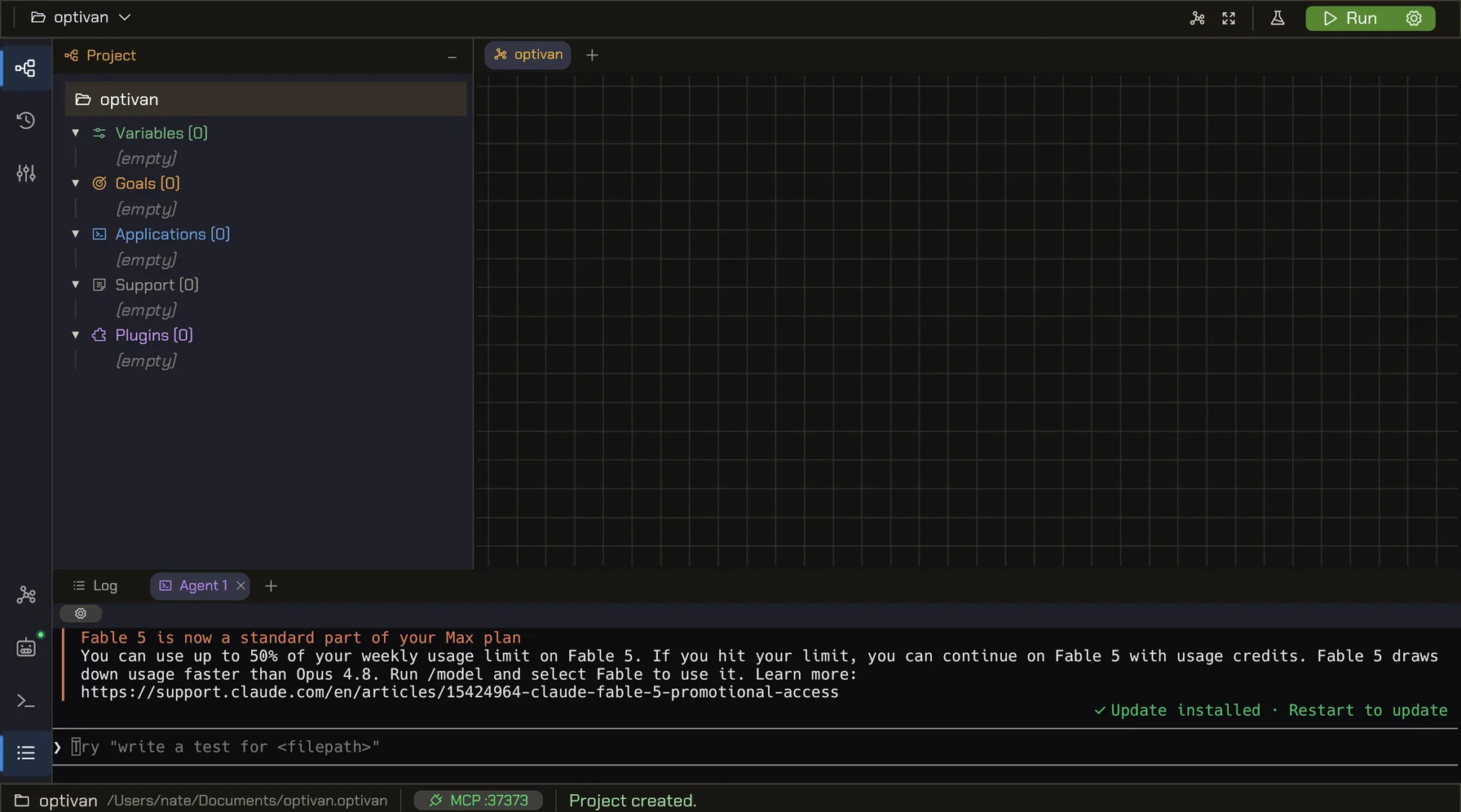
Then you type the question:
Minimize the mass of a simply supported steel I beam over a 2 m span.
Four section variables. Keep bending stress under 165 MPa, midspan
deflection under span over 360, and lateral torsional buckling
utilization under 0.667.
And you watch it become a study. Variables appear with proposed bounds. Evaluators wire themselves into objectives and constraints, with each limit set on the constraint node where it belongs. The graph gets validated, test run once to prove the pipeline, and then a design of experiments seeds a surrogate, an optimizer spends a 150 evaluation budget, and the AI watches the run so you do not have to.
At the end: a converged design at 12.93 kg, a plain language summary of which constraints came out active, a ranking of which variables actually drove the outcome, and a convergence plot on the dashboard. Both thicknesses pinned at their manufacturing minimums, exactly what a structures engineer would expect. Every step verifiable on the canvas, every number inspectable.
This is not a demo reel. It is the shipping product, and the full worked study publishes here soon with every number in it.
The engineer moves up, not out
Let us be precise about what the AI cannot do, because the precision is the point.
It does not know your physics. The bounds it proposes are sensible defaults, not judgment. It cannot certify an answer: a converged optimum is a mathematical statement about a model, never a statement about a structure. And it will not rescue a bad question. Optimize the wrong objective and it will optimize it beautifully.
So the engineer does not leave the loop. The engineer rises in it. Deciding what to optimize. Judging whether an answer makes physical sense. Choosing the next question. The typing, the wiring, and the babysitting go to the machine, where they always belonged. A tool that automates judgment is a hazard; a tool that automates toil is a colleague.
Serious tools run on your hardware
AI with tool access deserves careful thought about what it can reach. Our answer is architectural, not contractual: the workbench and its MCP server live on your machine, the AI talks to localhost, and your models, meshes, and results never leave your network. You choose which AI to run, in your own terminal, on your own account, and the tool grants it exactly the workbench capabilities and nothing else. On the yearly plan, even the license never touches a network.
The industry default of uploading crown jewel models to someone else's cloud was always a bargain struck for convenience. The moment the convenience runs locally, the bargain is over.
Tools should be priced like tools
A team lead should be able to read this page, download the product, and run the beam study before the afternoon ends, without a discovery call, a scoping workshop, or a five figure purchase order. Serious optimization for the price of a nice keyboard per month is not a promotion. It is what becomes possible when a tool is built lean and sold honestly.
Already installable
What exists today is the first rung: sentence in, study out, engineer in command. The next rungs are visible from here. AI that watches a long run overnight and adjusts when evaluations start failing. AI that reads a finished study and proposes the next one. AI that notices a constraint is never active and asks whether it belongs at all. None of it requires the engineer to step aside. All of it requires tools built with AI in their bones rather than bolted on.
Engineering software spent twenty five years adding menus. The next five are about removing the distance between a question and a study. The future of engineering tools is not software that replaces engineers. It is software that finally respects their time.
// TRY IT ON YOUR OWN MODELS
Optivan is design optimization on your hardware
Visual node graph studies, DOE and surrogate optimization, native solver results readers, cluster execution, and AI one click away. Free beta, or Pro from $99 a month.
See plans product tour →